Posts

Melbourne's housing wars
Image
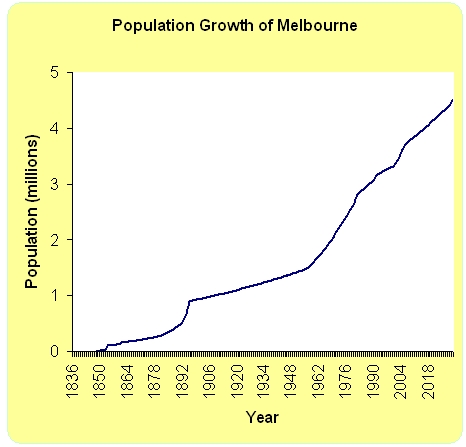
Cities are growing all over the planet. In considering Melbourne's housing problems, I was momentarily distracted by San Francisco. Seems there has been an influx of some 75 thousand people over the last decade, leading to some well publicised incidents: demonstrations at Google buses, posting of nasty signs. Serious, I thought. Then I realised that Melbourne is growing by some 50 thousand people every year. So where SF has struggled with 75 thousand, Melbourne has somehow dealt with 500 thousand. Wikimedia:  Biatch  at  en.wikipedia Impressive, I thought. Melbourne is successful. In a sense, yes. There are problems with success. It becomes expensive, for one. "The Economist" global housing prices. How can it be that it's more expensive to live in Melbourne than in London? At one level, it is the price of popularity.  How does it do it? Mostly by adding at the edges. The fastest growing areas are in the outer fringes of the city. Great...

Welcome to paradise...

Image
A traveller crosses the globe, "searching for a better place". They most likely have googled the destination so much, seen the images, imagined what it is going to be like. When they arrive, they are open to the sunshine, the beaches, the people. I live in Melbourne, Australia. Have almost all my life. Quite a lot of people arrive here with great expectations, excited that they have found a place that is so different to where they come from. For us residents, this is a bit weird. Melbourne is visually impressive. It's only a few kilometres to a beach where you don't have to fight for a patch of sand. If you get up early enough in the morning, you might have it to yourself. The sun shines, a lot. It doesn't snow. The economy, if not booming, is certainly powering along. If you've just got off the plane from Ireland, or Spain, or the crowded cities of Asia, or the cold of Germany, then I guess it looks pretty good. I've only lived outside Australia ...

A policeman wearing google glasses interviews you...

In the near future, you might face an interview with a policeman or woman wearing the google glasses. How might it go? First he/she might ask you your name. The glasses have access to images of you from various databases. If you give a false name he will know  straight away. Let's say you are on a train. He might ask where you are off to today. The ticket you carry has a unique number linked to your identity. He will know where you boarded the train.  He might ask where you work. Linked to the tax office database, he will have your complete work history.  What changes with the glasses is the immediacy. Especially in identifying you. Much of crime fiction is nostalgic. Typically (e.g. Rebus) the detective is an older male, quite uncomfortable with technology. He relies on younger people around him to make use of it. Even then, not a great deal of surveillance is employed. There might be some trawling through CCTV footage. Is the past somehow more human? O...

Ride a bicycle to evade the surveillance state.

My novel  'Murder in the Fabric'  is set in Melbourne in 2020. The preferred mode of transport is to don the hoodie and the dark glasses. Then get onto your bicycle, and move freely wherever you like in the city. There is nothing distinctive about pedalling that will give the forces of darkness a handle. I'm a big fan of the Jack Reacher books. I have read almost all of them. Jack is ex-military, the quintessential outsider. He has a bank account somewhere, but not much else. Drifting from place to place, he encounters trouble, and deals with it. In the books, the Jack Reacher character is physically quite large. Large enough to stand out in a crowd. Of course the character goes back quite a while, and mostly he is in small towns in the mid-west of America. He doesn't carry a mobile phone, all transactions are in cash. If he checks into a hotel then he invents a new name each time. In the modern surveillance state, how long would Jack last in a big city without be...

Cycling inland Australia in the winter

Image
It's really Tom's fault. After all, if you can cycle Norway in the winter   then Australia should be possible, surely? Australians tend to live close to the sea. So when they take off by bicycle they tend to follow the coast. Lots of bike tourers also. Some even go the whole way around. I've cycled the coast of Tasmania, Victoria, and New South Wales. Not all of it, but a lot of it. I'm in awe of people who go the whole way around, but the distances in Western Australia are beyond my reach now. If you are Australian, be prepared for comments like "why ?" or "there's nothing there...". Out here you won't meet many Australians. Some adventurous Germans, or Swedes, or Japanese. Despite having some of the most wonderful scenery in the world, Australians are highly urbanised and mostly not mentally equipped for the outback. I want to recommend two tours I've done that are in the "less pedalled" category. Not quite as unusual...

Tasmania: heaven for bicycle tourers

I toured Tasmania from Devenport south to Hobart, then up the East coast back to Devenport. It was so easy just to roll my bike onto the ferry. But what makes touring Tasmania so great? Scenery Of course. You don't want to be riding along a multi-lane highway with cars zooming past. Tasmania has great scenery. From the plateau and the wonder of the great lakes in the middle, to the wildness of the west coast. There is lots of it. Camping Where I live, in Victoria, they have spent a lot on "no camping" signs. Almost every spot you might think to stop for the night has one.  Even in National Parks: they make sure they don't clear the bush and leave a spot where you can put the tent. Lots of parks have no camping at all.  In Tasmania there are more free camping spots than you can throw a rock at. You might pass four or five in a day. Even better, quite a few towns have free camping in the middle of town. How incredibly civilised. Road Signs In the age of...

Zero Dark Thirty: not your normal review

The story in a sense is well known. The question this movie asks is: "what does it take to hunt down someone like Osama Bin Laden?" Most reviews compare and contrast with "Hurt Locker", but I haven't seen this. There is no broad focus, no real insight into the workings of the CIA.  We don't learn a lot about Pakistan. It follows Maya, who becomes obsessed with Osama Bin Laden. I don't want to give away details, but at one point the hunt has gone very cold, and it is looking very very unlikely that it will be successful. Maya is upset, and a colleague asks her "what are you going to do?" and she replies that she is going to hunt him down, and kill him.  The statement hangs in the air, and at the same time looks ridiculous, and brave. Portrayal of torture? To me it showed the toll it takes on the interrogator as well as the interrogated. It strongly hints at the truth that most people will most likely say anything that will stop the interrog...